Our Services
We offer treatment for all Skin Conditions, Rashes, Cancers, Toenail fungus, Scabies, Rosacea, Dermatitis, Acne, Psoriasis, Itch, and more!
Please scroll down to the bottom for examples of skin cancers.
We also offer the Blue light treatment from DUSA using Levulon. Please review the following video for more information.
Also, the Light box for Psoriasis.
Skin cancer is an abnormal growth of skin cells. It most often develops on areas of the skin exposed to the sun’s rays. Skin cancer affects people of all colors and races, although those with light skin who sunburn easily have a higher risk.
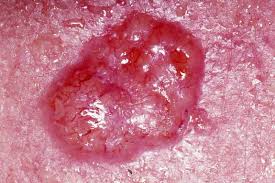
Basal Cell Carcinoma
BCCs are abnormal, uncontrolled growths or lesions that arise in the skin’s basal cells, which line the deepest layer of the epidermis (the outermost layer of the skin). BCCs often look like open sores, red patches, pink growths, shiny bumps, or scars and are usually caused by a combination of cumulative and intense, occasional sun exposure.
BCC almost never spreads (metastasizes) beyond the original tumor site. Only in exceedingly rare cases can it spread to other parts of the body and become life-threatening. It shouldn’t be taken lightly, though: it can be disfiguring if not treated promptly.
More than 4 million cases of basal cell carcinoma are diagnosed in the U.S. each year. In fact, BCC is the most frequently occurring form of all cancers. More than one out of every three new cancers is a skin cancer, and the vast majority are BCCs.
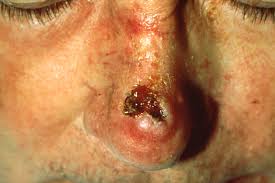
Squamous Cell Carcinoma
Squamous cell carcinoma (SCC) is an uncontrolled growth of abnormal cells arising in the squamous cells, which compose most of the skin’s upper layers (the epidermis). SCCs often look like scaly red patches, open sores, elevated growths with a central depression, or warts; they may crust or bleed. They can become disfiguring and sometimes deadly if allowed to grow. More than 1 million cases of squamous cell carcinoma are diagnosed each year in the U.S., and (depending on different estimates) as many as 8,800 people die from the disease. Incidence of the disease has increased up to 200 percent in the past three decades in the U.S.
SCC is mainly caused by cumulative ultraviolet (UV) exposure over the course of a lifetime; daily year-round exposure to the sun’s UV light, intense exposure in the summer months, and the UV produced by tanning beds all add to the damage that can lead to SCC.
SCCs may occur on all areas of the body including the mucous membranes and genitals, but are most common in areas frequently exposed to the sun, such as the rim of the ear, lower lip, face, balding scalp, neck, hands, arms and legs. Often the skin in these areas reveals telltale signs of sun damage, including wrinkles, pigment changes, freckles, “age spots,” loss of elasticity, and broken blood vessels.
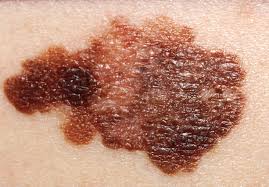
Melanoma
The most dangerous form of skin cancer, these cancerous growths develop when unrepaired DNA damage to skin cells (most often caused by ultraviolet radiation from sunshine or tanning beds) triggers mutations (genetic defects) that lead the skin cells to multiply rapidly and form malignant tumors. These tumors originate in the pigment-producing melanocytes in the basal layer of the epidermis. Melanomas often resemble moles; some develop from moles. The majority of melanomas are black or brown, but they can also be skin-colored, pink, red, purple, blue or white. Melanoma is caused mainly by intense, occasional UV exposure (frequently leading to sunburn), especially in those who are genetically predisposed to the disease. Melanoma kills an estimated 10,130 people in the US annually.
If melanoma is recognized and treated early, it is almost always curable, but if it is not, the cancer can advance and spread to other parts of the body, where it becomes hard to treat and can be fatal. While it is not the most common of the skin cancers, it causes the most deaths. In 2016, an estimated 76,380 of these will be invasive melanomas, with about 46,870 in males and 29,510 in women.
Q: What causes melanoma?
A: Melanoma is primarily caused by overexposure to UV radiation from the sun or tanning beds, which damages the DNA in skin cells. While sunburns and UV exposure are significant risk factors, melanoma can develop in people who have never had a sunburn. Genetics, a weakened immune system, or the presence of unusual moles can also contribute to melanoma risk, regardless of sun exposure. This myth can lead to a false sense of security, so it’s essential to stay vigilant about skin health even if you rarely burn.
Q: What does melanoma look like?
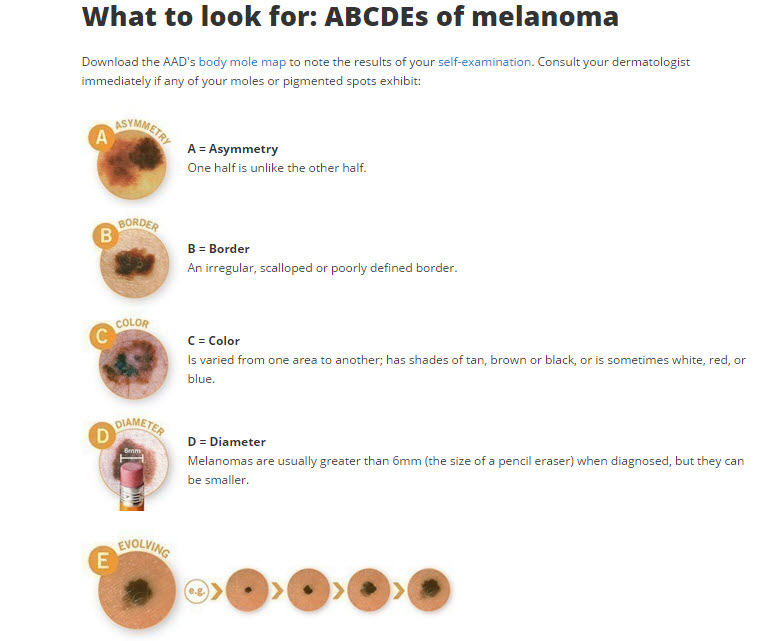
A: Melanoma can appear as a new or changing mole or dark spot, often irregular in shape, with uneven color, or an asymmetrical border. It may look black, brown, pink, or even red and can sometimes bleed, itch, or become tender. The “ABCDE” rule can help: look for asymmetry, irregular borders, multiple colors, diameter larger than a pencil eraser, and any evolution in size, shape, or symptoms. A dermatologist can assess spots that show these signs.
Q: Does skin cancer only come from sun exposure?
A: It’s true that sun exposure makes up the majority of melanoma cases. However, other risk factors include genetics, age, and immune health. As mentioned above, you can be genetically predisposed to having melanoma even if you are careful in the sun. Additionally, if you have already had melanoma, your likelihood of reoccurrence will increase significantly.
Q: Does sunscreen fully protect me from skin cancer when I am exposed to the sun?
A: The majority of skin cancers are caused by excessive exposure to UV rays. According to the American Cancer Society, even while wearing a broad-spectrum sunscreen, some UV rays can still get through the “filter” of an SPF. Because of this, sunscreen is only considered one part of following a smart sun safety plan. Other habits you should adopt are staying in the shade, covering up with long-sleeved clothing, and wearing a hat and sunglasses. If you can, try to avoid the sun altogether between 10 a.m. and 4 p.m. when the sun is at its highest intensity. Be sure to choose sunscreen with an SPF of 30 or higher, and reapply every two hours, or directly after swimming or sweating.